
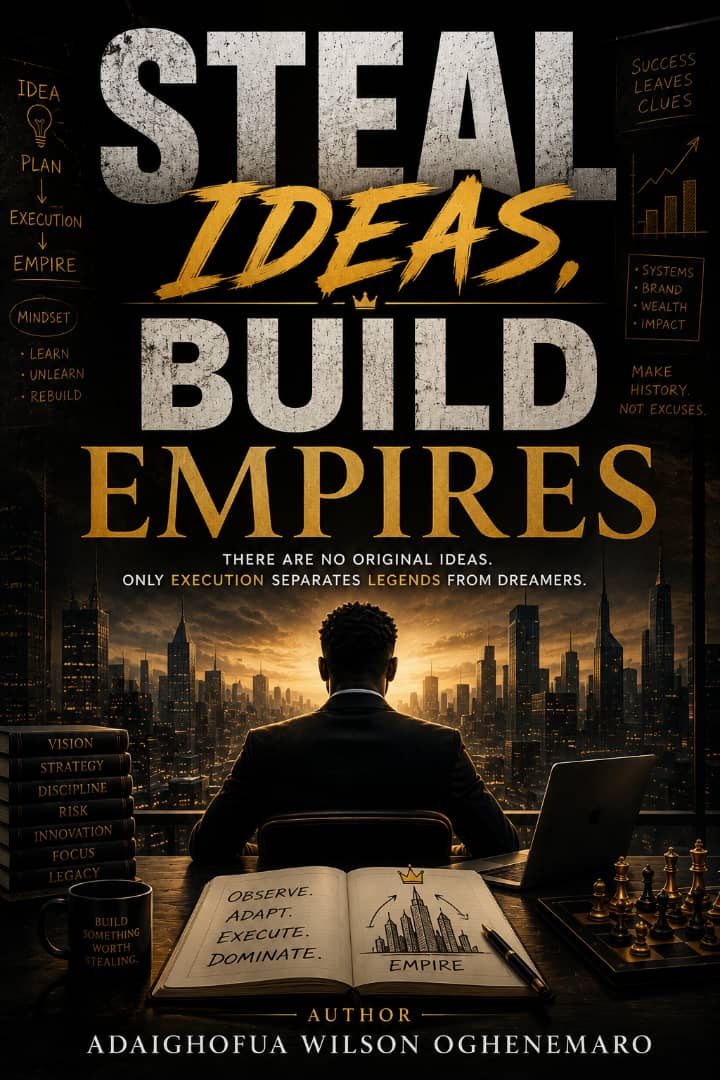
You don’t need a new idea. You need a better execution of an old one.
I know that sounds wrong. Because we were all raised on the same story: "The next billionaire will invent something no one has ever seen."
But look around. The richest people alive didn’t invent most of what they sell. They stole it. Then they outworked everyone.
This chapter will hurt your ego. Good. Let’s break it.
--- 1. THE LIE THAT KEEPS YOU BROKE
"Be original."
That advice sounds noble. In business, it’s expensive.
Originality means: - No proof it works - No one to copy - No customers who understand it - No playbook to follow - You have to invent AND sell at the same time
That’s like trying to build the airplane while flying it. Most people crash.
The ego loves originality because it feels safe. "If no one else is doing this, no one can compare me." But it also means: "No one is buying this."
Originality is a trap because it makes you the guinea pig. And guinea pigs rarely become millionaires.
Meanwhile, the person who copied, improved, and sold faster is already cashing out.
2. HISTORY IS WRITTEN BY THE THIEVES
Let’s stop pretending.
Apple didn’t invent the personal computer. Xerox did. Apple went to Xerox PARC, saw the mouse + GUI, and said "we can do this better." Now Apple is worth $3 trillion.
Google didn’t invent search. AltaVista, Yahoo, Lycos were there first. Google stole the idea of "search engine" and made the results 10x more relevant. Now Google runs the internet.
Starbucks didn’t invent coffee. Italians did. Starbucks stole the coffee shop, added couches, WiFi, and a brand story. Now there’s one on every street.
McDonald’s didn’t invent the burger. White Castle did. McDonald’s stole the fast-food system, standardized it, and franchised it to 40,000 stores.
Facebook didn’t invent social media. MySpace and Friendster were first. Facebook stole the concept, made it for college kids, and executed with ruthless focus.
Amazon didn’t invent online shopping. Netflix didn’t invent movies. Tesla didn’t invent electric cars.
They all did the same 3 things: See what works → Steal it → Make it 10x better → Scale it until no one can catch them.
Inventors get TED Talks. Thieves get empires.
3. WHAT "STEAL" ACTUALLY MEANS
Before you call your lawyer, let me be clear.
I’m not telling you to plagiarize books or counterfeit products. That’s stupid and illegal.
Business stealing = Study + Deconstruct + Rebuild + Improve
Here’s how it works:
STEP 1: STUDY Find 3 people already making money in the space you want. Not influencers. Operators. People with customers, reviews, and receipts. Watch them for 30 days. Screenshot everything. What do they sell? How much? How do they deliver? How do they market?
STEP 2: DECONSTRUCT Break their business into Lego pieces. Offer. Price. Audience. Traffic source. Sales process. Delivery. What’s the engine and what’s just decoration?
Example: A fitness coach sells $50 workout PDFs. Engine: "Pay me, get PDF, lose weight." Decoration: The colors, the font, the name.
STEP 3: REBUILD Now change ONE variable. Same engine, new car. - Different person: "Workout PDFs for new moms" - Different speed: "24-hour delivery instead of 7 days" - Different price: "Half price but group coaching" - Different location: "What works in the US, bring to Lagos" - Different experience: "Better support, better branding"
STEP 4: IMPROVE Find the 1 thing they suck at and become world-class at it. Slow replies? You reply in 5 minutes. Confusing product? You make it stupid simple. Bad packaging? You make it beautiful.
That’s stealing. And it’s 100% legal.
4. WHY COPYING BEATS INVENTING 9 TIMES OUT OF 10
Reason 1: Proof of Demand If someone is already making money, the market has voted. You don’t have to convince people they need it. You just have to convince them your version is better.
Starting from zero costs time, money, and faith. Starting from 1 costs execution.
Reason 2: The Blueprint Exists You can buy their product. You can watch their ads. You can read their reviews. You can see their pricing page.
Original founders spend 2 years figuring out what to build. You spend 2 weeks figuring out how to build it better.
Reason 3: You Focus On Sales, Not Invention Most startups die because they can’t explain what they do. You don’t have that problem. People already understand the category. Your job is to steal market share, not create a category.
Speed kills. And copying is fast.
5. THE 3 TYPES OF LEGAL THEFT
There are only 3 things worth stealing in business:
TYPE 1: STEAL THE IDEA Take the core concept and put it in a new container.
Uber: "Taxis, but with an app." Airbnb: "Hotels, but in people’s homes." Zoom: "Meetings, but on your laptop." Same idea. New delivery.
Ask: "What’s working in another country that isn’t here yet?"
TYPE 2: STEAL THE SYSTEM Take how they operate and apply it somewhere else.
McDonald’s stole the factory assembly line and put it in a kitchen. Amazon stole the Sears catalog and put it online. Fitness coaches stole the university course structure and put it on WhatsApp.
Look at boring industries and steal their systems for exciting ones.
TYPE 3: STEAL THE DISTRIBUTION Take how they get customers and do it better.
Every TikTok creator stole YouTube formats and made them 15 seconds. Every brand stole podcast audiences by sponsoring shows. Every e-commerce store stole Instagram influencers.
If you can’t build a better product, build a better way to reach people.
Most people only steal Type 1. Empires are built by people who steal all 3.
6. HOW TO STEAL WITHOUT BEING A LAZY COPYCAT
This is where 90% of people fail. They copy the surface and wonder why they lose.
Don’t copy the paint job. Copy the engine.
LAZY COPY: Someone sells "trading signals for 10k/month." You sell "trading signals for 10k/month." You will die.
SMART STEAL: Someone sells "trading signals for 10k/month." You sell "trading signals + 1-on-1 risk management for 10k/month for students in Lagos." Same engine. Different car. You win.
The formula: Their Core + Your Twist + Your Audience = New Business`
Your twist can be: - Niche: For tailors, for pastors, for students - Speed: 24 hours vs 7 days - Price: Cheaper, or 3x more expensive with premium service - Experience: Better packaging, better community, better support - Geography: Take what works in Abuja to Benin City
When you add a twist, you’re not a copy. You’re an upgrade.
7. WHERE TO FIND THINGS WORTH STEALING
Stop waiting for inspiration. Go shopping.
SOURCE 1: OTHER COUNTRIES Whatever is blowing up in the US, UK, or South Africa today will blow up in Nigeria in 12-18 months. Spend 30 minutes a day on: TikTok US, Product Hunt, Gumroad, Twitter, YouTube Shorts. Find what’s selling. Bring it home and localize it.
SOURCE 2: OTHER INDUSTRIES A restaurant loyalty card → becomes a barber loyalty card. A university lecture → becomes a WhatsApp course. A gym membership → becomes a content subscription.
Steal across lanes. No one is watching.
SOURCE 3: YOUR COMPETITORS’ REVIEWS Go to their Instagram comments. Go to their Google reviews. Find the complaints: "Delivery was slow" "Customer service was rude" "Too expensive" Each complaint is a business opportunity. Build the version that fixes it.
SOURCE 4: THE PAST Most "new" ideas are 50 years old with an iPhone. Read old business books. Study old ads. The principles don’t change. Only the tools do.
8. THE EGO PROBLEM
This is the real reason people don’t steal.
The ego says: "I want to be known as original. As a genius. As a creator." The bank account says: "I want to be known as rich. As free. As dangerous."
You can’t serve both.
Empire builders have no ego about where ideas come from. Walt Disney stole from the Brothers Grimm. Jeff Bezos stole from Walmart’s logistics. Elon Musk didn’t invent cars or rockets.
They stole, improved, and out-executed.
Your job is not to be the most creative person in the room. Your job is to be the most effective person in the market.
Kill the ego. Keep the money.
9. THE ETHICS QUESTION
"Isn’t this shady?"
No. If it was illegal, they’d sue you. If it was wrong, the market wouldn’t reward you.
Every industry is a remix. Restaurants copy menus. Clothing brands copy designs. Software companies copy features.
The only difference is: amateurs copy the surface. Professionals copy the system and improve it.
As long as you’re not lying, not scamming, and not stealing IP directly, you’re just competing. And competition is how the world gets better products.
10. CASE STUDY: THE BORING WAY THIS WORKS
Let’s say you want to start a food business.
Original approach: Spend 6 months inventing a "new cuisine." No one understands it. No one buys it. You quit.
Steal approach: 1. See that "shawarma + delivery" is working in Lagos. Proof of demand. 2. Deconstruct: They sell via Instagram, deliver in 1 hour, price is 4k. 3. Rebuild: You do "shawarma + delivery in 30 minutes for students in UNIBEN." 4. Improve: Better packaging, loyalty card, reply to DMs in 2 minutes.
Same idea. New twist. You win.
That’s how empires start. Boring. Obvious. Profitable.
11. YOUR 48-HOUR ASSIGNMENT
Don’t just read this. Do it.
Today: 1. Pick 1 industry: food, fashion, fitness, finance, content, etc. 2. Find 3 people making money in it right now on WhatsApp/Instagram/TikTok. 3. Write down: What they sell, price, audience, and how they deliver.
Tomorrow: 4. Read their reviews and DMs. Find 3 complaints. 5. Design your version with 1 twist that fixes a complaint. 6. Post it. Sell it. Take payment.
You just stole your first idea.
12. FINAL WORD
Originality is a trap because it isolates you. Stealing puts you in a line that’s already moving.
You don’t need to invent fire. You need to build a better stove. You don’t need to invent the car. You need to build a faster delivery service.
The world doesn’t pay for ideas. The world pays for execution.
So stop brainstorming in your room. Start studying in the market.
Steal the blueprint. Build the product. Scale the system. Own the lane.
That’s how you build an empire.
And it starts with admitting this truth:
Originality is overrated. Execution is everything.